Doctor Dust by Bullshark Games: Four Grid Boosters and Free Spins Without a Fixed Limit

Doctor Dust is a high-volatility online slot released by Bullshark Games on 9 October 2026. Set in a polluted, post-apocalyptic wasteland, the game follows a mysterious plague doctor searching abandoned ruins for useful components. Its central feature is a collection system that rewards consecutive cascading wins with four different Grid Boosters. These can transform symbols, create Wilds, duplicate rows and introduce multipliers worth up to 100x. The 5×5 playing grid supports cluster wins rather than traditional paylines, while two bonus modes, Surface Search and Toxic Vault, offer free spins that can continue without a predetermined maximum number. With a published maximum win of 12,000 times the stake, Doctor Dust combines substantial potential payouts with considerable risk and an unusually detailed collection mechanic.
Doctor Dust Gameplay: Cluster Wins, Cascades and Symbol Collection
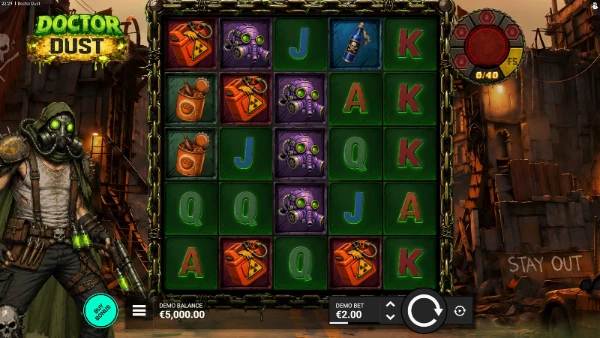
Doctor Dust uses a square arrangement of 25 positions, organised into five rows and five columns. Instead of following fixed paylines, the game awards wins when four or more matching symbols form a connected cluster. Winning symbols disappear from the grid, allowing new symbols to fall into the available positions. This process, known as cascading, continues whenever another qualifying combination appears. Several wins can therefore occur within a single paid spin without requiring another wager. The important distinction is that a cascade does more than increase the number of potential payouts: every winning symbol removed from the grid also contributes to the collection system responsible for unlocking the game’s special features.
The collection bar beside the grid contains five segments, each requiring eight winning symbols. Collecting eight symbols unlocks the first random Grid Booster, while totals of 16, 24 and 32 unlock the remaining three. Reaching 40 collected symbols within the same paid spin activates the Surface Search bonus. Each Booster can appear only once during a spin, and its order is determined randomly. Collection progress resets when a new base-game spin begins, so gathering 24 symbols in one spin does not mean the next starts with three filled segments. This makes long cascading sequences particularly important. A spin that creates several modest clusters may advance the collection bar further than a single large combination that ends immediately.
The published game specifications list two return-to-player settings: 96.30% and 94.26%, depending on the casino’s configuration. The corresponding hit frequencies are approximately 20.65% and 20.64%, while volatility is rated at the highest level, 5 out of 5. Standard euro-denominated stakes range from €0.10 to €75, although the exact options depend on the version offered by the operator. The maximum advertised win is 12,000x the stake, subject to a monetary limit of €900,000 or its currency equivalent. RTP describes a theoretical return calculated across a very large number of plays, not the result of an individual session. High volatility means that substantial payouts are possible, but extended periods of small wins or losses are also part of the game’s risk profile.
How the Collection Bar Changes an Ordinary Spin
The collection system is best understood by following the number of symbols removed rather than simply counting winning combinations. Suppose an initial cluster contains five symbols, and the resulting cascade creates another cluster containing four. The collection bar now records nine winning symbols, enough to unlock the first Grid Booster. If the subsequent changes produce another seven qualifying symbols, the total becomes 16 and the second Booster is unlocked. Further cascades may activate the third and fourth Boosters before the spin finishes. These figures illustrate the collection thresholds rather than a guaranteed sequence. The actual progression depends on the symbols generated and whether the game continues producing connected clusters.
Once a Booster becomes available, it is applied after the current grid has settled. If several Boosters have been unlocked, they activate individually in a random order. The grid is evaluated again after each activation, and any new winning combinations create further cascades. This gives the collection system an important feedback effect: winning symbols unlock a Booster, the Booster modifies the grid, and those modifications may generate additional winning symbols. However, none of these transformations guarantees another successful cluster. An apparently promising spin can still finish before reaching 40 symbols, while a less impressive opening arrangement may develop into a longer sequence through repeated changes.
The collection bar continues counting symbols even after the 40-symbol bonus threshold has been reached. Every additional group of eight winning symbols increases a central counter by one, up to a maximum of four. This counter determines how many segments are already filled at the start of the bonus game’s subsequent-spin collection process, affecting the number of Boosters guaranteed on the second spin when that spin occurs. A total of 72 collected symbols reaches the maximum counter value and qualifies for Toxic Vault rather than the standard Surface Search feature. Because these thresholds must be reached through the same base-game spin and its cascades, they depend on a particularly extended sequence of winning symbol removals.
Four Grid Boosters: Clone, Switch, Wilds and Power Line
The four Grid Boosters form the main gameplay distinction of Doctor Dust. Each changes the playing area in a different way, but their combined effects are more significant than their individual actions. Clone duplicates symbols and existing multipliers, Switch reorganises symbols within selected rows, Wilds introduces substituting symbols, and Power Line creates additional multiplier positions. All four are unlocked through the same collection bar and awarded in a random order. The game does not allow players to select a preferred Booster or decide which one activates first. As a result, identical collection totals can produce very different outcomes depending on the arrangement of symbols and the sequence of transformations.
Clone copies one randomly selected row into either one or two adjacent rows. This can produce new clusters by repeating a useful arrangement of matching symbols across several horizontal positions. Any cell multipliers already attached to the source row are copied as well. If a destination cell already contains a multiplier, the copied value is added to the existing value rather than replacing it. Wild symbols occupying the affected destination rows remain in their positions. Clone can therefore strengthen an existing multiplier arrangement while preserving valuable Wilds. Nevertheless, copying a row does not automatically create a paying cluster, particularly when the duplicated symbols fail to connect with matching symbols elsewhere on the grid.
Switch changes between one and three randomly selected rows, transforming the symbols in each affected row to match that row’s first symbol. This can create extensive groups of identical symbols across the playing area, especially when neighbouring rows already contain matching symbols. Existing Wilds remain unchanged, and multipliers attached to individual grid positions stay in place. Unlike Clone, Switch does not duplicate multiplier values or move them between cells. Its primary purpose is to alter symbol arrangements, potentially allowing new clusters to include positions that already carry multipliers. The difference matters because a multiplier contributes to a payout only when its cell becomes part of a qualifying win.
Wild Symbols, Power Line and the Rules Behind Cell Multipliers
The Wilds Booster places between two and five Wild symbols in random grid positions. A Wild can substitute for any regular paying symbol, helping complete or extend clusters that would otherwise remain disconnected. Wilds do not appear naturally during ordinary symbol drops in Doctor Dust; they are introduced exclusively through this Booster. Some Wilds also carry multipliers, with possible values of 2x, 3x, 4x, 5x, 10x, 15x, 20x, 25x, 50x and 100x. When a multiplier-bearing Wild lands, its multiplier is attached to that grid position. If the selected cell already contains a multiplier, the new value is added to the existing amount.
Power Line removes the ordinary symbols from one randomly selected row and one randomly selected column before filling the affected positions with new symbols. Existing Wilds in those positions remain untouched, and newly generated symbols cannot be Wilds. Every affected cell receives a random multiplier chosen from the same 2x to 100x range used by multiplier-bearing Wilds. The cell where the selected row and column intersect receives two multiplier values, which are added together. Existing cell multipliers also increase by the newly awarded values. For example, a cell containing a 10x multiplier that receives another 25x becomes a 35x position. This creates opportunities for substantial payouts when later cascades include the affected cells.
Cell multipliers are tied to positions on the grid rather than permanently attached to the symbols occupying them. When several multiplied cells contribute to one winning cluster, their multiplier values are added together before being applied to that cluster’s payout. For instance, winning cells carrying 10x and 20x multipliers would produce a combined 30x multiplier for the relevant win, not a 200x multiplication. After a multiplied cell participates in a winning combination, its multiplier is removed together with the winning symbols. Clone can duplicate multiplier values before they are used, while Switch and Wilds may help create matching clusters across multiplied positions. These interactions explain how several comparatively simple Booster effects can combine to produce much larger payouts without guaranteeing them.
Surface Search and Toxic Vault: Free Spins Without a Fixed Maximum
Doctor Dust includes two collection-based bonus modes, each using the same fundamental cascading and Grid Booster mechanics as the base game. Surface Search activates after at least 40 winning symbols are collected during a single paid spin. It guarantees a minimum of one free spin, beginning with all four Grid Boosters available. Once the initial grid has settled, those Boosters activate individually in a random order, with the grid evaluated for further winning combinations between activations. Unlike slots that award a fixed starting package of ten or fifteen free spins, Doctor Dust uses symbol collection to determine whether another spin is earned. The number of additional spins therefore depends on the results of the feature itself.
During Surface Search, the collection bar changes to four segments containing eight symbols each. Collecting at least eight winning symbols during a bonus spin fills the first segment and awards another free spin. Reaching 16, 24 or 32 symbols fills additional segments and determines how many Grid Boosters will be available on the following spin. A spin collecting eight to fifteen symbols therefore earns another spin with one Booster, while a spin collecting 32 or more symbols awards another spin with all four Boosters. The collection count resets to zero at the beginning of every bonus spin after the first. Progress does not accumulate indefinitely between individual free spins, so each one must meet the continuation requirement independently.
The feature finishes when a free spin collects fewer than eight winning symbols. There is no preset upper limit on the number of free spins that can be awarded through successive qualifying spins, but this does not mean the feature is guaranteed to continue for a long period. For example, a bonus spin collecting 24 symbols earns another spin with three Grid Boosters. If that next spin collects only six symbols, the feature ends despite having three Boosters available. Conversely, repeated spins that each collect at least eight winning symbols can extend the feature beyond the number of spins usually found in conventional bonus rounds. The unlimited retrigger system concerns the possible duration of the bonus, not unlimited payouts or a guarantee of reaching the game’s maximum win.
How Toxic Vault Differs and What Players Should Check
Toxic Vault is the higher-threshold bonus mode, requiring at least 72 winning symbols during a single base-game spin. It awards two guaranteed free spins rather than the one-spin minimum associated with Surface Search. Both initial spins have all four Grid Boosters available, making the second spin the key difference between the two bonus modes. After these guaranteed spins, continuation follows the same eight-symbol collection rule used in Surface Search. Further free spins can be awarded whenever the collection requirement is met, and the number of Boosters available on the next spin depends on the previous spin’s collected symbols. Toxic Vault therefore provides a stronger starting position without changing the underlying randomness of the outcomes.
The differences between the two bonuses become particularly clear when a spin fails to produce enough winning symbols. In Surface Search, collecting fewer than eight symbols on the first free spin ends the feature immediately. Toxic Vault guarantees a second spin with four Boosters even if the first spin does not reach that threshold. However, the second guaranteed spin does not mean that additional spins must follow. If its collection total is insufficient, the feature can finish after the guaranteed allocation. The benefit of Toxic Vault is therefore its additional all-Booster opportunity, not a guaranteed minimum payout. Both bonus modes remain subject to the overall 12,000x maximum win limit, which can be achieved in any of the game’s modes.
Before playing Doctor Dust for real money, it is worth checking the exact RTP shown in the casino’s game information panel, since the developer supplies both 96.30% and 94.26% configurations. The available stake levels, optional feature-purchase controls and any applicable regional restrictions should also be checked directly in the game. A free demo, where offered, can help explain the collection bar, Booster activation order and bonus continuation rules without risking money. The game’s highest volatility rating makes a predetermined spending limit particularly important, especially because repeated cascades and an open-ended bonus can create the impression that a major payout is approaching. In practice, every spin is governed by chance, and neither previous losses nor partially completed collection sequences improve the probability of a future win.